Almost everyone wants their parent's life written down. Far fewer manage it. The intention is beautiful; the follow-through is where it dies — a notebook that stays blank, a "record your life" gift that gathers dust, a year that slips by with the best stories still untold.
It doesn't have to be that way. Capturing a life is less about discipline than about lowering the bar, choosing the right format, and asking in a way that makes someone want to talk. Here's how to actually do it — and finish.
Why most attempts stall
Understanding why these projects fail is half the battle, because the failure is almost always structural, not personal.
- The format is too much work for them. Mailing an elderly parent a weekly writing prompt asks them to sit at a keyboard and compose an essay. Most won't, and it isn't laziness — it's friction.
- It's framed as one enormous task. "Write your memoir" is paralysing. "Tell me about the summer you were sixteen" is a pleasure.
- Nobody follows up. The magic is in the second and third question, and a blank page never asks them.
- There's no finish line. Effort with no visible progress and no end result quietly stops.
Fix those four things and the rest is easy. Here's how.
Choose the format that fits them, not you
The best format is the one your parent will actually use — which is rarely the one that's easiest for you.
- Talking beats typing, almost always. Older people who'd never write a paragraph will happily talk for an hour. Speech is where the real voice, the humour, and the tangents live.
- In person is lovely; a phone call works too. Don't let distance stop you. A recorded phone or video call is more than enough.
- Meet them where they're comfortable — the kitchen table, the garden, the armchair they always sit in. Comfort loosens tongues.
Whatever you choose, keep the barrier near zero. The moment it feels like admin, it stops.
Record the audio — a transcript isn't enough
This is the single most important decision, and the one people most often get wrong: capture their voice, not just their words.
A transcript keeps what they said. A recording keeps how they said it — the pause before the punchline, the catch in the throat, the laugh, the particular way only they tell that story. Years from now, reading their words will be precious. Hearing them will be something else entirely.
A transcript keeps what they said. A recording keeps the sound of them saying it — and that's the thing you can't get back any other way.
You don't need equipment. The voice recorder already in your phone is fine. Just press record before you start, and let it run.
Ask questions that open people up
The quality of what you get is set almost entirely by the questions. Two rules carry most of the weight.
First, be specific. "Tell me about your childhood" gets you a shrug. "What did your mother's kitchen smell like on a Sunday?" gets you a whole world. Concrete, sensory, small — those are the doors people walk through.
Second, follow the thread. Whatever you had planned matters less than what they just said. If a question about their first job surfaces the friend they made there, chase the friend. The follow-up — "and what happened to them?" — is where the gold is.
If you'd like a running start, we've put together 101 questions to ask your parents, grouped by theme and ready to use. Pick a handful, not all of them.
Make it little and often
A life doesn't have to be captured in one sitting — and it shouldn't be. Marathon sessions are exhausting and easy to postpone forever.
- Aim for fifteen or twenty minutes at a time, a few times, rather than one grand afternoon.
- Tie it to something that already happens — a weekly call, a Sunday visit.
- Let it wander. Some of the best material comes from a question you never planned to ask.
Small, repeatable, low-pressure. That's what actually accumulates into a life.
Turn it into something that lasts
Loose recordings on a phone are a start, but they're fragile and easily forgotten. The reason to finish — to shape it into something real — is that a thing gets kept, shared, and handed down in a way that a folder of audio files never is.
That might be a simple transcript you tidy up, a private podcast for the family, or a printed book. What matters is that it becomes an object with an ending, not an open-ended project that stalls at eighty percent.
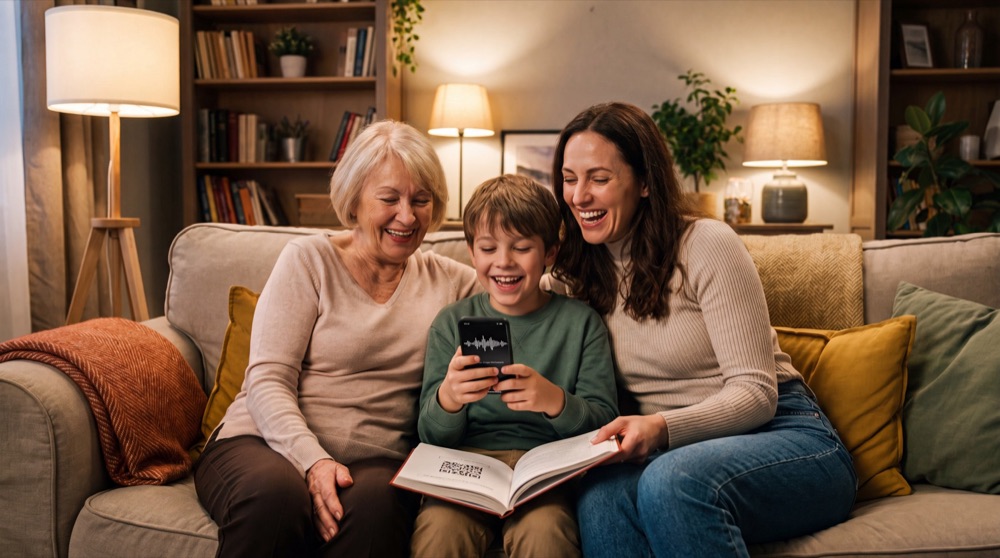
If the whole arc — the asking, the following-up, the transcribing, and the finishing — is more than you can realistically take on, that's precisely the gap Told was built to close. It interviews the person gently by voice, with no app to learn and no account to set up, follows the thread of whatever they say, and turns it all into a real, printed book — with a QR code on every chapter that plays the moment back in their own voice.
However you do it, the method matters less than the starting. Lower the bar, press record, ask one good question, and begin. The stories are worth keeping, and the people who tell them won't wait forever.